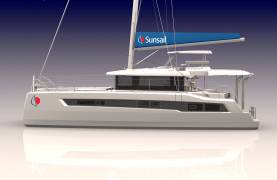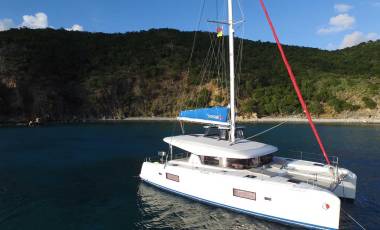
Sunsail Lagoon 424 – 4 cabin
4
Cabins
42'0"
Length
10
People

If you’re trying to decide which is better – a catamaran or monohull, choosing the right hull configuration is the first real step in planning an adventure on the water, as your choice of yacht shapes your entire live-aboard experience.
At Sunsail, our award-winning fleet is made up of monohulls and catamarans, so whichever you choose, you’re covered.
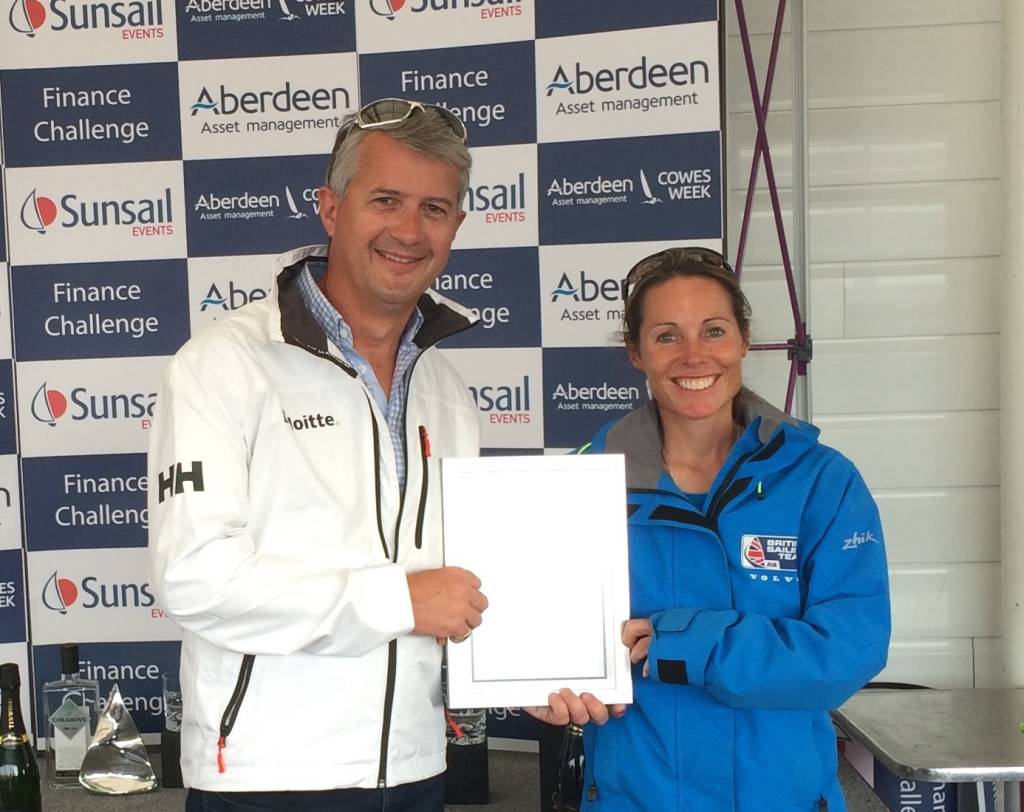
To help unpack the benefits of a monohull vs a catamaran, we joined Paralympic sailing icon and Sunsail ambassador Helena Lucas MBE on her recent charter. Having spent her life sailing classic monohulls, Helena stepped aboard a Sunsail catamaran in the BVI to benchmark the two experiences side-by-side.

“We were really fortunate to be given a Sunsail 444 Catamaran for two weeks in the BVI’s. Neither myself nor my husband have ever sailed a catamaran, not even a dinghy, so it was a really different experience for us both! We have always sailed monohulls and have our own 33-foot yacht, so we were intrigued to see what it was going to be like!” – Helena Lucas MBE
While both options provide the ultimate freedom to explore at your own pace, they offer distinctly different experiences during sailing and when anchored.
| Feature | Catamarans | Monohulls |
| Stability | Flat, level sailing with minimal heel. Keeps things beautifully steady on deck. Ideal for relaxed family moments and socialising on the move. | Leans naturally into the breeze. Delivers that classic, visceral sailing sensation that true holiday sailors thrive on. |
| Space & Layout | Wide-open decks and 360-degree views. Offers expansive shared areas in the saloon and separate hulls for quiet privacy when you anchor up. | Cosy, secure, and classic. A traditional nautical layout that naturally brings your crew together for authentic shared experiences down below. |
| Draft (Depth) | Shallow draft. Lets you glide effortlessly into quiet, secluded anchorages and tuck closer into shallow bays. | Deeper draft. Requires keeping an eye on the depth chart, but provides rock-solid tracking through open water. |
| Upwind Performance | Wider tacking angles upwind. More about enjoying a relaxed, comfortable journey than pinching the breeze. | Points tight to the wind. Offers crisp, responsive control—perfect for putting your sailing skills to the test. |
| Manoeuvrability | Twin-engine confidence. Gives you the power to literally spin on a dime, making tight marina berths completely stress-free. | Classic agile handling. A single engine paired with a highly responsive rudder for a spirited, traditional feel at speed. |


How a boat is built completely shapes how you and your group experience life on the water.
Because a catamaran uses two hulls bridged by a wide central platform, the beam (width) remains consistently wide from bow to stern. This opens up massive, open deck spaces and those classic forward trampolines that everyone gravitates toward the second the anchor drops.
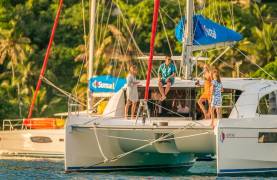
“The Cat offers amazing accommodation, especially the 444 for only two people! We effectively had a hull each, with two double cabins and two heads – enough sleeping accommodation for four couples. The main living area has a 360-degree vista with fantastic cooking facilities, a large fridge, a great seating area, and most importantly, a generator allowing for air-conditioning and modern appliances like a microwave, smoothie maker, coffee machine, etc., without needing shore power. There were so many great places to relax on the boat, whether you wanted to sunbathe or escape the heat and relax in the shade and the cooling breeze. We had some great evenings barbequing and eating on board in stunning anchorages. We loved the dinghy davits; just a push of a button, and the dinghy was hoisted from the water and stowed at the back of the boat. For us, the live-aboard experience was amazing!” – Helena Lucas MBE
A monohull features a single, traditional hull that sits lower in the water, offering a completely different rhythm to your time onboard.

When determining which is better, a catamaran or a monohull, the answer usually depends on how you want to interact with the wind.
There is nothing quite like the feeling of a monohull slicing cleanly through the waves, leaning beautifully into the breeze to find its natural groove. For true sailors, that visceral connection to the sea is exactly why we leave dry land behind. Monohulls point beautifully tight to the wind and track straight through head seas, giving you crisp, responsive control as you chart technical, multi-island routes.
Catamarans, on the other hand, trade the traditional heel for pure straight-line speed. Because they stay level, everything on the water feels effortlessly stable. You won’t need to spend twenty minutes locking down every mug and loose item below deck before pulling up the mainsail. It is a relaxed, high-comfort way to travel, though it means the skipper needs to keep a closer eye on the breeze and the boat’s reefing guides to judge when to drop sail area as the wind builds.
When you are slipping into a tight marina at the end of a brilliant day on the water, both yachts handle the task exceptionally; they just use a different kind of expertise:

“The sailing experience was very different from what we are used to, and it took us a little time to adapt to the motion of the boat and also understand how to get the best out of her. We had an amazing sail from Virgin Gorda to Anegada, a tight reach in 18 knots. At times we touched 9 knots boat speed, even with a reef in the main, and quickly caught and passed the monohulls. We found the reefing guide next to the helm to be a really useful and accurate guide to how much sail area we should have in the various wind conditions. Something that is quite obvious in a monohull but not in a cat, which doesn’t heel over.
However, we did feel limited by the amount of sailing we could do, as catamaran performance upwind and downwind is inferior to that of a monohull, but they are great fun on a reach, and you never have to worry about your drink falling over and making sure everything is stowed properly before setting sail. Under power, considering the size of the boat, it was really easy to manoeuvre with the twin engines, and by splitting the throttles, you could spin the boat in its own length.” – Helena Lucas MBE
Choose a Catamaran If…
Choose a Monohull If…
When looking over the costs, the pricing for each setup reflects the unique style of on-water experience you are choosing:
Sunsail 424 (4 Cabin)
Built by world-leading innovators at Robertson & Caine, this catamaran features an advanced forward cockpit walk-through, bridging the salon directly to the forward bow trampoline.
Sunsail 454 (4 Cabin)
Optimised for natural illumination, the hull portlights flood the lower cabins with light. It features a raised helm station providing commanding views of both sails and all four corners of the craft during close-quarters mooring.

Featured Monohulls
Sunsail 41.0 (3 Cabin)
From the legendary Jeanneau Sun Odyssey range, this monohull features an innovative hard-chined hull designed to slice through drag and keep the boat beautifully balanced under a stiff breeze.
Sunsail 46 (3 Cabin)
Crafted by Beneteau, this premier yacht blends clean, sleek hull lines with a massively wide cockpit layout. Dual helms keep you in complete control, while centralised winches allow easy short-handed line management right from the wheel.
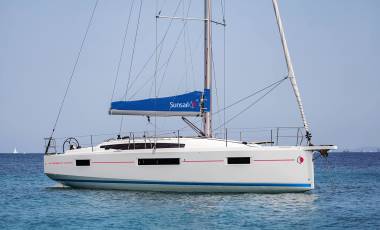

In summary, if you want an amazing liveaboard experience with all your creature comforts, are able to move your spacious catamaran from one hidden anchorage to the next, and are not too bothered whether you sail or not, the catamaran is for you. The cat is also ideal for families with young children because of the space and the fact that it’s very stable, which makes it safe and easy to move around.
However, if you are passionate about sailing and want to make the most of the amazing sailing conditions the BVIs have to offer, the monohull is probably the boat to choose. In the winter months, December to April, you can expect NE-E trade winds of 5-20 knots, sometimes gusting up to 30. Properly reefed, these make for some fantastic sailing days on the beautiful Caribbean Sea.

FAQs
Cruising catamarans are designed for stability. They carry extensive weight and wide-beam dynamics that keep it firmly planted on the water. By following standard sail reefing parameters, they are incredibly safe platforms.
Seasickness is triggered by different motions. Monohulls roll and heel smoothly, which many find predictable and rhythmic. Catamarans do not heel, but they do mimic the pitch and roll of the waves with a quicker, more linear motion. For passengers who dislike the sensation of a boat leaning over, a catamaran offers a reassuringly level platform.
Sunsail’s monohulls feature centralised winches, rolling furling genoas, and stack-packs, making them incredibly easy to adjust from the safety of the cockpit. While catamarans have heavier line loads, their twin-engine configurations make them simpler to position while picking up a mooring buoy.

Start your experience with Sunsail on land and sign up to receive e-mails from us about yachts, offers and destinations.
By clicking 'Sign up' you confirm that you have read and understood our Privacy Policy and consent to our use of your information.